

Can the same electrolysis treatment be considered cosmetic for one FSA claim and medically necessary for another? The purpose of treatment and the documentation supporting it can matter, so using FSA for electrolysis treatments isn’t automatically approved or ruled out by the treatment name alone.
It’s understandable to want clarity before paying out of pocket, especially when a claim could be denied. Electrolysis is generally treated as cosmetic when pursued for appearance alone, but an FSA administrator may consider a claim when a healthcare provider documents a medical purpose and the plan’s rules allow it. A Letter of Medical Necessity may support a claim, but it doesn’t guarantee reimbursement.
This guide explains what can affect eligibility, what to ask your FSA administrator, and which records to gather before submitting a claim. It also distinguishes reimbursement paperwork from direct billing. North Bay Electrology provides appointment-based electrolysis and insurance reimbursement paperwork. Understanding the steps can help you plan without assuming approval in advance.
Key Takeaways
- Before using FSA for electrolysis treatments, review your plan’s rules and ask the administrator how it evaluates claims involving a medical purpose.
- Appearance-focused treatment and medically documented treatment may be reviewed differently. Supporting records can explain the purpose, but the administrator decides whether a claim qualifies.
- Prepare a claim by gathering provider documentation, plan forms, payment records, and any other evidence your administrator requests.
- Keep copies of your submission and note your plan’s deadlines so you can track the claim and respond to requests for more information.
- North Bay Electrology provides appointment-based electrolysis for the face, neck, body, and sensitive areas, as well as pre-surgical care. The clinic provides reimbursement paperwork, not direct billing.
Using FSA for Electrolysis Treatments: What to Know First
Electrolysis may or may not qualify for FSA reimbursement, depending on applicable tax rules, your plan’s terms, and the documented purpose of treatment. The treatment name alone doesn’t settle the question. Before paying with the expectation of reimbursement, find out how your plan reviews expenses and what evidence it may require.
A health Flexible Spending Account (FSA) is an employer-sponsored account that lets eligible employees set aside funds for eligible expenses under applicable rules. Having money available in your FSA doesn’t mean every expense can be reimbursed. Your account balance and a particular treatment’s eligibility are separate questions.
Electrolysis is a method of removing hair. For background on the practice itself, see Electrology (Electrolysis). That general description doesn’t determine whether your expense qualifies. Eligibility depends on relevant tax guidance and your plan’s requirements, so review current information rather than relying on the treatment label or a general online list.
What an FSA can, and cannot, tell you about eligibility
Your plan documents explain how your FSA works, and the administrator’s procedures describe how to submit and support a claim. Applicable tax guidance provides another part of the framework. Together, these sources can help you understand the process, but they don’t promise that a specific expense will be approved.
General eligibility information can help you assess a claim, but only your FSA administrator can decide how your plan will process it. Ask how the administrator evaluates electrolysis expenses and what records it needs. Doing this before treatment can help you understand the potential for paying out of pocket if a claim is denied. This information is general, not individualized tax or legal advice.
Why the purpose of electrolysis matters
The reason for treatment can affect how an expense is reviewed. Electrolysis sought for personal appearance may be viewed differently from treatment a healthcare provider documents as part of care for a medical condition. A documented medical purpose may be relevant, but it doesn’t automatically make a claim eligible or guarantee reimbursement. The administrator applies your plan’s rules to the information submitted.
For example, someone seeking hair removal for appearance-related reasons and someone whose provider recommends it as part of a treatment plan may have different supporting records. These examples don’t determine eligibility, and a diagnosis alone doesn’t confirm that an expense qualifies. Ask what documentation is required for your circumstances before relying on reimbursement.
People seek electrolysis for personal, medical, and gender-affirming reasons. You deserve clear, respectful answers without having to share more than the information required for a claim. Understanding the difference between treatment purpose, supporting documentation, and plan approval is a practical first step toward using FSA for electrolysis treatments with more confidence.
How FSA Rules May Apply to Electrolysis Expenses
Federal tax guidance offers a starting point, but it doesn’t make the final decision on an individual FSA claim. The IRS’s IRS Publication 502 on Medical and Dental Expenses explains general standards for medical expenses and discusses limits on expenses for cosmetic procedures. It’s written for federal tax purposes, so it isn’t a claim-specific ruling for every FSA plan.
In general, the reason for an expense matters. Medical expenses are considered in relation to care such as diagnosing, treating, or preventing disease, while cosmetic procedures may be treated differently. Publication 502 describes exceptions for certain cosmetic surgery needed to improve a deformity related to a congenital abnormality, injury, or disfiguring disease. That discussion doesn’t establish whether electrolysis qualifies in a particular case. Applying tax guidance to your circumstances may require qualified tax advice.
Cosmetic purpose and medically directed treatment
Electrolysis pursued for personal appearance may be reviewed differently from treatment a clinician recommends as part of care for a medical condition. When a medical purpose is involved, a clinician’s letter or treatment plan may help explain the diagnosis, why hair removal is recommended, and the intended course of care. Documentation isn’t an automatic exception: the relevant tax rules and your FSA’s requirements still apply.
An administrator may, for example, ask for a Letter of Medical Necessity that connects the recommended treatment to a specific medical need. The exact information required can vary, and no diagnosis or letter alone confirms that an expense is eligible. Keep the explanation factual and limited to what the claim requires.
Plan terms, administrator decisions, and evidence
Before submitting a claim for using FSA for electrolysis treatments, read your plan’s eligible-expense rules and reimbursement instructions. If the wording doesn’t address electrolysis, ask the administrator how it reviews the expense and what documentation it expects. A written response can help you prepare, though it isn’t necessarily a guarantee of reimbursement.
The administrator evaluates your documentation under the plan’s applicable requirements. Provider paperwork can support the medical purpose, but it doesn’t replace plan forms, payment records, or other evidence the administrator requests. Keep the response and your documents together so you can refer to the same instructions when filing.
- Save the administrator’s written guidance and note any claim-submission deadline.
- Keep provider letters or treatment records that explain the medical purpose, if relevant to your claim.
- Retain the plan’s required forms and proof of payment, and provide only the information requested.
Once you understand what your plan requires, you can plan care and paperwork more deliberately. North Bay Electrology provides appointment-based electrolysis and insurance reimbursement paperwork. This support is separate from direct FSA billing. For care in the North Bay, review appointment-based electrolysis services.
Electrolysis FSA Claims: Compare Common Situations Carefully
The reason for electrolysis can shape the records an FSA administrator asks to review, but it doesn’t decide eligibility by itself. Use the comparison below to prepare questions and organize documentation, not as a ruling on whether your expense will be reimbursed.
Appearance-focused treatment versus documented medical purpose
Describe your reason accurately and in your own words. Consider whether you’re seeking treatment for personal appearance or whether a healthcare provider has recommended it as part of care for a medical concern. Identify the records that explain the recommendation. A diagnosis or clinician’s note may provide context, but neither automatically changes an expense’s status under your plan.
Appearance-focused treatment
Purpose: Hair removal pursued for personal appearance or preference.
Possible records: A receipt or itemized statement showing the service and payment, plus any forms your plan requests.
Administrator review: Ask whether the plan considers this type of expense eligible and what evidence it requires. Don’t assume approval based on the service name.
Treatment documented for a medical purpose
Purpose: Hair removal described by a healthcare provider as part of care for a specific medical concern or treatment plan.
Possible records: Provider documentation explaining the medical purpose and recommendation, along with receipts and plan forms. The administrator may request additional information.
Administrator review: The plan evaluates the submitted records under its requirements. Documentation can support the explanation, but it doesn’t guarantee reimbursement.
These categories are prompts for clearer communication, not labels for your personal circumstances. If your situation doesn’t fit neatly into either description, explain it factually to your administrator and ask what documentation would help with its review.
Pre-surgical and gender-affirming electrolysis considerations
For pre-surgical hair clearance, the surgical team’s instructions may identify the treatment area, purpose, or timing relevant to preparation. Keep those instructions and related provider documentation together, then compare them with your FSA plan’s evidence requirements. Surgical preparation is a distinct context, not a guarantee of coverage across plans.
People may seek pre-surgical or gender-affirming electrolysis for different reasons and follow different care plans. Your records should reflect your own situation, without including more personal detail than the administrator needs to assess the claim. North Bay Electrology provides pre-surgical electrolysis by appointment. Learn more about pre-surgical electrolysis care.
Before submitting a claim, compare your documents with the administrator’s written instructions. Check that the records clearly describe the treatment purpose, include the requested payment information, and match any required forms. This preparation can make your submission easier to review, while the administrator decides whether the expense meets your plan’s applicable requirements.
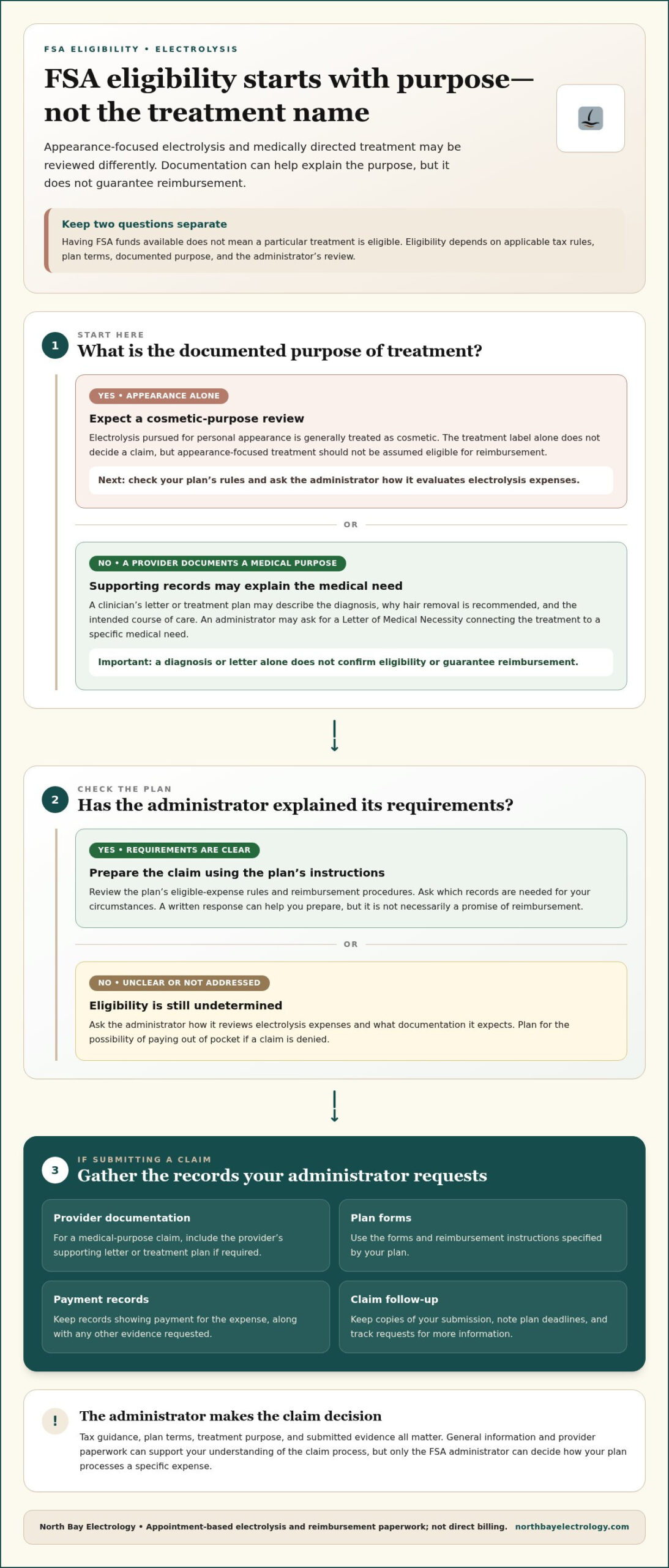
How to Prepare an FSA Reimbursement Claim for Electrolysis
A careful claim starts with your plan’s instructions, not a stack of paperwork gathered at random. Before using FSA for electrolysis treatments, confirm what your administrator requires, how to submit the claim, and the deadline that applies to your plan. Procedures and timelines vary, so use your plan’s rules rather than a general checklist as the final authority.
- Check your plan rules. Review eligible-expense information, claim forms, submission channels, deadlines, and instructions for expenses that need additional documentation. Save or print the relevant guidance.
- Ask the administrator. If the rules don’t clearly address electrolysis, ask how the plan reviews it and what records it needs. Request written instructions when possible, and keep the reply with your claim documents.
- Gather records by source. Collect provider documentation separately from plan forms and payment evidence. If a clinician has recommended electrolysis for a medical purpose, ask the administrator whether it needs a supporting statement and what that statement should address.
- Submit as directed. Use the required form and submission method. Include only the information and supporting evidence requested, and check that service dates and payment details are legible.
- Retain copies and follow up. Save your full submission and confirmation of receipt. If the administrator asks for more information or denies the claim, review the explanation, follow the plan’s appeal or resubmission instructions, and keep copies of any response.
What to gather before submitting a claim
Your administrator’s instructions determine which records to include. Depending on the plan, useful documents may include:
- An itemized receipt or statement showing the date of service, treatment description, and payment information.
- Completed FSA forms or other evidence the plan specifically requests.
- A clinician’s supporting statement, if the administrator requires documentation of a medical purpose.
Protect sensitive health information by submitting only what the administrator requests. Store copies securely in case you need to follow up.
How to submit and follow up without assuming approval
Follow the administrator’s designated channel, forms, deadlines, and file requirements. A submitted claim isn’t the same as an approved claim. If you receive a request for additional information, respond to the specific questions and retain a copy. If the claim is denied, use the plan’s instructions to understand whether more documentation or a review is available.
North Bay Electrology provides insurance reimbursement paperwork to support clients’ records, but doesn’t bill insurance or FSA plans directly. The administrator reviews and decides the claim under your plan’s requirements. Electrolysis services are provided by appointment.
Plan Electrolysis Care With North Bay Electrology
Once you understand your FSA administrator’s requirements, you can consider the care that fits your needs and plan your next steps. North Bay Electrology provides electrolysis for the face, neck, body, and sensitive areas, as well as pre-surgical hair clearance. Whether your reason is personal, medical, gender-affirming, or related to surgical preparation, your care deserves a respectful, thoughtful approach.
What local electrolysis care can support
Electrolysis can be part of a personal hair-removal plan or a medically directed process. For pre-surgical care, treatment planning may relate to instructions from your surgical team. Individual needs and goals differ, so don’t assume another person’s treatment plan or FSA experience will apply to yours. North Bay Electrology serves clients in Petaluma, Novato, Cotati, Rohnert Park, Santa Rosa, Sonoma, Napa, Vallejo, San Rafael, Sebastapol, American Canyon, Terra Linda, Corte Madera, Windsor, and Healdsburg.
Appointments are required. Before arranging care, consider what you want treatment to address and whether you have instructions or records relevant to your plan. If you’re using FSA for electrolysis treatments, keep the financial question separate from the care decision: your administrator determines whether a claim qualifies, while you decide what treatment meets your needs.
Choose a practical next step
Review your plan’s requirements before relying on reimbursement. If the administrator requests provider paperwork, identify which records it needs and whether the information should describe the treatment purpose, service dates, or another detail. North Bay Electrology provides insurance reimbursement paperwork, not direct billing. You submit your claim, and FSA approval depends on your plan and administrator.
A simple plan can help you move forward without assuming an outcome:
- Keep the administrator’s written instructions with your claim records.
- Gather only the provider documentation and payment records the plan requests.
- Save copies of forms and submissions, and note any deadline that applies to your account.
- Arrange an appointment when you’re ready to discuss electrolysis care.
There’s no need to rush a decision about reimbursement or treatment. Clear information about both can help you choose a next step that feels right. If you’re in Petaluma or another North Bay community, review appointment options below.
Direct insurance billing isn’t available. Reimbursement paperwork is separate, and FSA approval remains plan-dependent.
Take Your Next Step With Clarity
Planning care can begin with one manageable step: write down your remaining questions about your FSA and the treatment you’re considering. A clear response from your administrator can help you decide how to proceed, while keeping reimbursement expectations separate from your personal care goals. Using FSA for electrolysis treatments may involve plan-specific review, so give yourself time to make an informed decision.
Your reasons for seeking electrolysis are personal and deserve respect. Whether you’re gathering information or ready to plan care, you can move forward at your own pace. Appointment options are available when you’re ready.
May your next step bring greater clarity and confidence in the choices ahead.
Frequently Asked Questions
Can I use my FSA for electrolysis treatments?
Possibly, but having an FSA balance or payment card doesn’t establish that electrolysis is eligible. Before using FSA for electrolysis treatments, ask whether your administrator requires advance review, a medical-necessity letter, or a specific invoice format. For example, confirm whether it wants documentation for each visit or accepts a treatment-plan record alongside receipts. Treat general eligibility information as guidance, not approval of your individual claim.
Is electrolysis considered a medical expense for FSA purposes?
It depends on the purpose of treatment and the rules that apply to your account. Electrolysis for personal appearance may be assessed differently from care connected to a documented medical need. A tax definition and an FSA administrator’s claim process are related, but they aren’t interchangeable. If you’re unsure how the guidance applies, ask your administrator to explain its review criteria, and seek qualified tax advice for personal tax questions.
Can I use FSA funds for gender-affirming electrolysis?
It may be possible if the treatment is documented as part of medically directed gender-affirming care and your plan accepts the expense. Ask your administrator what a clinician’s letter should explain, such as how hair removal relates to your care plan and what treatment is recommended. Requirements vary, and a diagnosis or supportive letter alone doesn’t ensure reimbursement. Your care needs are personal, and you should share only the medical details required for review.
What documentation might an FSA administrator request for electrolysis?
Depending on its rules, the administrator may request an itemized receipt, service date, treatment description, proof of payment, claim form, or a clinician’s statement explaining medical necessity. Ask which records are required before sending sensitive information. If you’re organizing documents while arranging care in Petaluma, Novato, Cotati, Rohnert Park, Santa Rosa, Sonoma, Napa, Vallejo, San Rafael, Sebastapol, American Canyon, Terra Linda, Corte Madera, Windsor, or Healdsburg, store copies securely and keep them separate from unrelated health records.
Can I pay for electrolysis with my FSA card and still be denied reimbursement?
Yes. A card transaction going through doesn’t necessarily mean the expense has passed the plan’s full eligibility review. The administrator may later request a receipt or other substantiation, or determine that the expense doesn’t meet the plan’s rules. Keep the receipt even if the card appears to work, and respond to documentation requests. If the card is declined, ask the administrator how to submit an expense for review.
What happens if my FSA claim for electrolysis is denied?
Read the denial notice to identify the reason, such as missing documentation or an eligibility concern. Then check your plan’s instructions for submitting additional records, correcting the claim, or requesting an appeal, along with any applicable deadline. Ask the administrator to clarify what information it needs, and keep copies of your follow-up. A resubmission or appeal may receive further review, but reimbursement isn’t assured.
To discuss face, neck, body, sensitive-area, or pre-surgical electrolysis, view appointment options with North Bay Electrology.

Article by
Madison Hanselman
As a trans woman and owner of North Bay Electrology in Petaluma, I bring a deep personal empathy and love for technical systems to my practice. My own transition fuels my passion for permanent hair removal, making my clinic a proud partner and safe haven for the LGBTQ+ community. Balancing rigorous analytics with heartfelt care, I approach electrology as both a precise science and a life-changing path to self-actualization.