

What if the most critical factor in your surgical recovery happens eighteen months before you ever enter the operating room? For many, the road to gender-affirming bottom surgery feels like a marathon of paperwork and anticipation, but the physical preparation of your skin is just as vital as the procedure itself. Undergoing electrolysis for vaginoplasty is a clinical necessity that ensures your new anatomy remains healthy and free from the complications of internal hair growth. We understand that this process can feel overwhelming, especially when you’re balancing the anxiety of a long timeline with the need for precise, permanent results.
You deserve a transition supported by both clinical expertise and deep, empathetic care. This guide provides a trauma-informed roadmap to help you manage every step of your hair removal journey. You will learn how to navigate insurance reimbursement using current 2026 standards, what to look for in a specialized electrologist, and how to structure your appointments to meet your surgeon’s requirements. By following this checklist, you can move toward your surgery date with a clear plan and the confidence that your health and comfort are being prioritized every step of the way.
Key Takeaways
- Understand why permanent electrolysis for vaginoplasty is the only clinical standard to prevent post-operative internal hair growth and related infections.
- Learn how to structure your 12-to-18-month preparation timeline to ensure you meet your surgeon’s strict clearance requirements before your procedure date.
- Discover effective strategies for managing physical sensitivity, including the proper application of topical numbing agents and the critical role of systemic hydration.
- Master the insurance reimbursement process by identifying the specific documentation and medical necessity letters required for coverage in 2026.
- Identify the essential qualities of a trauma-informed specialist who provides both the clinical precision and the psychological safety necessary for sensitive genital work.
Why Electrolysis is the Clinical Requirement for Vaginoplasty
Pre-surgical electrolysis is a medical necessity for donor site preparation that ensures the long-term safety and health of your future anatomy. While many steps of your transition involve personal choice, permanent hair removal is a strict clinical mandate from your surgical team. Most gender-affirming procedures like vaginoplasty rely on using existing skin to create the vaginal canal and labia. If the follicles on this donor skin aren’t completely destroyed, hair will continue to grow inside the body once the tissue is relocated. This isn’t just an aesthetic concern; it’s a significant health risk. Internal hair growth often leads to chronic inflammation, recurring infections, and the formation of painful abscesses that are notoriously difficult to treat after surgery.
Surgeons specifically require electrolysis for vaginoplasty because it’s the only method recognized by the FDA for permanent hair removal. Other methods might offer temporary relief, but they don’t provide the clinical certainty required for a successful surgical outcome. When hair is trapped within the vaginal vault, it can interfere with hygiene and dilation, potentially compromising the integrity of the surgical site. By committing to a thorough clearance plan, you’re actively preventing these complications and setting the stage for a smoother, healthier recovery.
The Difference Between Laser and Electrolysis for Surgery
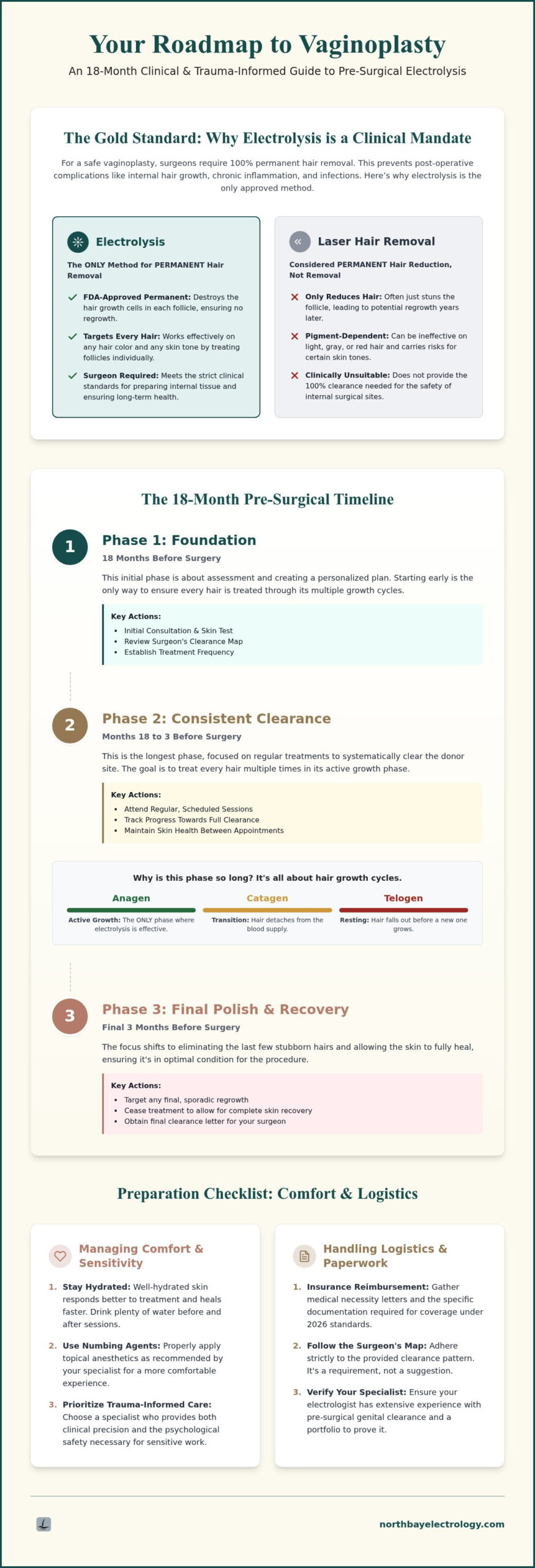
Laser hair removal is often marketed as permanent, but it’s technically categorized as “permanent hair reduction.” This distinction is dangerous for surgical candidates. Laser targets pigment, which means it may miss light-colored hairs or struggle with certain skin tones. Even when successful, laser may only stun the follicle, leading to regrowth years later. Electrolysis doesn’t rely on pigment. It targets each follicle individually with precise energy to ensure the germative cells are destroyed. At North Bay Electrology, we focus on this individual precision to achieve total clearance, providing a level of safety that laser simply cannot match for internal tissue preparation.
Surgeon-Specific Requirements and Clearance Patterns
Your surgical team will provide a specific “clearance map” based on the technique they use, such as penile inversion or a scrotal graft. These maps are not suggestions; they’re precise guides that show exactly which areas must be hair-free to avoid internal complications. Following these patterns exactly is the only way to ensure your surgeon has the healthy, clear tissue they need on the day of your procedure. Most surgical teams in California recommend starting this process at least 12 to 18 months in advance. This timeline allows your electrologist to treat every hair through multiple growth cycles, ensuring no dormant follicles are missed before your surgery date. You can schedule a consultation to review your surgeon’s specific map and begin your personalized clearance plan.
Your 18-Month Pre-Surgical Electrolysis Timeline Checklist
Planning for gender-affirming surgery is a multi-layered process that requires both patience and precision. While your surgical team handles the complexities of the operating room, your electrologist focuses on preparing the foundation. Following a structured timeline for electrolysis for vaginoplasty ensures you aren’t rushing in the final weeks, which can lead to skin irritation or incomplete clearance. This 18-month roadmap is designed to align with the clinical requirement for vaginoplasty, giving your body the time it needs to achieve permanent results and healthy tissue recovery. For a detailed breakdown of each stage, our electrolysis treatment timeline month-by-month guide provides the specific milestones you need to stay on track through 2026.
Phase 1: Starting the Journey in Petaluma
Your journey begins approximately 18 months before your scheduled or anticipated surgery date. This initial phase starts with a comprehensive consultation at our Petaluma studio to establish a baseline for your treatment. During this visit, we perform a test patch to observe how your skin reacts to the modality and to assess the density of the hair in the donor area. We’ll map out a session frequency plan that accounts for the three distinct stages of hair growth: anagen (active growth), catagen (transition), and telogen (resting). Because electrolysis only works on hairs in the anagen phase, starting early is the only way to ensure we capture every follicle as it cycles into view.
Phase 2 & 3: Consistency and Clearance
The first six to nine months represent the most intensive portion of your preparation. During Phase 2, aggressive weekly or bi-weekly sessions are often necessary to achieve your first “full clear.” This means every visible hair in the surgical zone is treated. Once we reach this milestone, we move into Phase 3, which focuses on thinning and maintenance. You’ll notice the density of regrowth dropping significantly, and we can begin to space out your appointments. It’s common to hit a “plateau” where it feels like progress has slowed; however, this is simply the process of catching the final, stubborn resting hairs. Consistency during this middle phase is what prevents internal regrowth after your procedure.
As you move toward the final stages of your timeline, the focus shifts from active removal to skin health. Phase 4 begins three to four months before your surgery. This is the period for final clearance and, crucially, skin rest. As an affirming expert in this field, my most vital advice is to avoid rushing these final months. Your skin needs time to fully heal and regain its natural elasticity before it’s repositioned by your surgeon. Incomplete healing can complicate the surgical site, so we aim to finish all intensive work well in advance of your hospital admission. If you’re ready to begin mapping out your personal timeline, you can book your initial consultation to start this partnership with confidence.
The Comfort Checklist: Managing Sensitivity During Treatment
Preparing for genital hair removal involves more than just showing up for your appointment. It requires a proactive approach to physical and emotional comfort. Genital work is naturally sensitive, but it’s a manageable part of your journey when you have the right tools and a supportive partner. Because pre-surgical hair removal is recognized as medically necessary for gender dysphoria, we prioritize your physical and psychological safety throughout every session. Your comfort isn’t just a preference; it’s a clinical priority that directly impacts the efficacy of your treatment.
One of the most effective ways to prepare is through systemic hydration. Maintaining high systemic hydration levels increases skin conductivity and reduces the overall sensation during the procedure. When your skin is well-hydrated, the follicle is more receptive to the probe, allowing for a smoother release of the hair. We recommend increasing your water intake significantly for at least 48 hours before your session to ensure your skin is in an optimal state for treatment.
Medical Pain Management Options
Topical anesthetics are a cornerstone of a comfortable experience. For maximum efficacy, apply a thick layer of 5% lidocaine cream approximately sixty to ninety minutes before your appointment. It’s essential to occlude the area with plastic wrap to prevent the cream from drying out or rubbing off on your clothing. This keeps the medication active and ensures it penetrates deep enough to dull the nerve endings. You should also consult with your primary care provider about prescription-strength numbing options or the use of over-the-counter anti-inflammatories like ibuprofen. Taking an anti-inflammatory thirty minutes before your session can help manage the localized swelling and sensitivity that naturally occurs during electrolysis for vaginoplasty.
Emotional and Psychological Preparation
The environment where you receive care matters as much as the technical skill of the electrologist. Our Petaluma studio is designed to be a non-judgmental, professional sanctuary where you can feel secure. We practice trauma-informed care, which means we prioritize your agency and boundaries. You’re always in control of the session. We encourage open communication and establish clear “stop” signals so you can take breaks whenever needed. Reducing procedural anxiety is a key part of our “Affirming Expert” approach, ensuring you feel validated and respected throughout this sensitive process. You can book your appointment knowing you’ll be supported by a specialist who views this work as a form of advocacy.
- Keep the treated area clean and dry to prevent irritation.
- Apply a cold compress or chilled witch hazel to soothe localized heat and swelling.
- Wear loose-fitting, breathable cotton clothing to minimize friction.
- Avoid hot tubs, saunas, and swimming pools to protect the open follicles from bacteria.
- Skip heavy exercise that causes excessive sweating for at least 24 hours.
Logistics Checklist: Insurance, Paperwork, and Travel
Managing the administrative side of your transition can feel just as demanding as the physical treatments themselves. While the focus of electrolysis for vaginoplasty is clinical, the success of your journey often depends on how well you navigate insurance requirements and schedule your life around your recovery. We view our role not just as technical specialists, but as partners in your advocacy. This means helping you secure the documentation necessary to prove that your care is a medical necessity rather than a cosmetic choice. By organizing your logistics early, you reduce the stress of the 12 to 18 month timeline and ensure your focus remains on your well-being.
Navigating Insurance Reimbursement
As of 2026, most major insurance providers recognize pre-surgical hair removal as a medically necessary component of gender-affirming care. To secure reimbursement, you’ll typically need a Letter of Medical Necessity (LMN) from both your surgeon and a mental health professional. These letters must explicitly state your diagnosis of gender dysphoria and explain why electrolysis is required for your specific surgical technique. When you work with us, we provide specialized insurance reimbursement paperwork that includes the necessary CPT code, 17380, which denotes a 30-minute electrolysis session. We also ensure your invoices contain the correct ICD-10 diagnostic codes, making the submission process to your provider as straightforward as possible. If you use a Flexible Spending Account (FSA) or Health Savings Account (HSA), these funds can also be utilized to cover your out-of-pocket costs while you wait for insurance processing.
Scheduling for Success in the North Bay
Our studio in Petaluma serves as a central hub for clients traveling from Santa Rosa, Napa, and San Rafael. We operate strictly by appointment only to ensure that every pre-surgical client receives dedicated, private care without the rush of a high-volume clinic. This privacy is vital for maintaining your psychological safety during sensitive treatments. When planning your sessions, consider the rhythm of your work life and the required 48-hour recovery window. Many clients find that scheduling sessions toward the end of their work week allows for a restful weekend of skin recovery. Coordination is key, and we work closely with you to map out a frequency that respects both your surgical deadline and your personal capacity for healing.
Choosing Your Specialist: Why North Bay Electrology is the Right Choice
Selecting the right specialist for your electrolysis for vaginoplasty is a decision that impacts your surgical outcome and your long-term comfort. Just as one might choose the Frankel Foot & Ankle Center for specialized bunion surgery, pre-surgical clearance requires a high level of clinical precision. At North Bay Electrology, we view our work as a vital form of advocacy for the LGBTQ+ community. We combine technical mastery with a deep understanding of the psychological and physical journey you’re on. This isn’t just about removing hair; it’s about providing the dignity and respect you deserve during a vulnerable and transformative time.
Specialized experience matters because the margin for error in surgical prep is zero. If a follicle is missed or improperly treated in a general setting, the result is simply regrowth on the skin’s surface. In the context of gender-affirming surgery, that same missed follicle could become trapped inside the body. Our “Affirming Expert” approach ensures that every hair is addressed with the methodical care required to meet strict surgical clearance maps. We don’t just clear the surface; we secure your future health.
Clinical Standards and Safety
We maintain a sterile, professional environment that reflects our commitment to medical-grade care. By utilizing only FDA-approved electrolysis techniques, we guarantee that the results are truly permanent. You can learn more about what to look for in professional electrolysis clinic standards to see how our practice exceeds these benchmarks. While our focus here is on surgical prep, we also prioritize face and neck treatments to support a holistic transition. This comprehensive care allows you to address multiple needs within a single, trusted partnership, ensuring your skin remains healthy and clear throughout your entire journey.
The North Bay Community Connection
Our clinic is proud to support clients throughout Sonoma, Marin, and Napa counties. We understand the unique challenges of coordinating gender-affirming care in the North Bay and strive to be a reliable, welcoming resource for our community. Permanent hair removal is an empowering step toward living authentically, and we’re here to ensure that step is taken with confidence. As we’ve discussed, Why Electrolysis is the Gold Standard for gender-affirming care is rooted in its clinical certainty and safety.
Finalizing your surgical preparation plan in Petaluma starts with a conversation. We invite you to reach out and establish a timeline that honors your goals and your surgeon’s requirements. Your journey toward a successful outcome is a marathon, and we’re ready to walk those 18 months with you. To begin your partnership with a specialist who prioritizes your safety and your results for electrolysis for vaginoplasty, visit our booking portal to schedule your initial consultation.
Securing Your Path to a Successful Recovery
Completing your surgical preparation is a profound milestone in your transition. By understanding the clinical necessity of permanent hair removal and adhering to a structured 18 month timeline, you’re actively preventing post-operative complications and ensuring the health of your new anatomy. You’ve learned that managing this journey involves more than just appointments; it requires a strategic approach to insurance documentation, physical comfort, and skin rest. Successfully navigating electrolysis for vaginoplasty is a marathon that rewards patience with the peace of mind that your results are truly permanent.
At North Bay Electrology, we’re dedicated to being your partner in this process. Our appointment-only studio in Petaluma provides a private, trauma-informed environment where your psychological safety is as important as our technical precision. We’re here to handle the specialized insurance reimbursement paperwork and provide the expert care you need to meet your surgeon’s requirements with confidence.
Your journey toward living authentically is a significant undertaking, and you deserve a specialist who views your care as a form of advocacy. We’re ready to support you through every step of your preparation, ensuring you arrive at your surgery date feeling empowered and fully prepared for your next chapter.
Common Questions About Pre-Surgical Electrolysis
How many hours of electrolysis are typically needed for vaginoplasty?
Total treatment time typically ranges between 50 and 150 hours to achieve the full clearance required for surgery. This number varies based on individual hair density and follicle depth. Because we must ensure every follicle in the donor site is permanently destroyed, we spread these hours over an 18 month period. This timeline lets us capture every growth cycle during your journey of electrolysis for vaginoplasty.
Can I do laser hair removal first and finish with electrolysis for surgery?
You can begin with laser hair removal to reduce density, but you must finish with electrolysis to ensure surgical safety. Laser is categorized as permanent reduction, which is insufficient for preventing internal hair growth after surgery. We recommend transitioning to electrolysis for vaginoplasty at least 12 months before your procedure to ensure every remaining follicle is individually and permanently treated.
Does insurance cover electrolysis for gender-affirming surgery in California?
Most insurance plans in California are required to cover electrolysis when it’s deemed a medical necessity for gender-affirming surgery. Coverage depends on your specific policy and the submission of a Letter of Medical Necessity. While we don’t bill insurers directly, we provide the detailed documentation and invoices you need to seek reimbursement from your provider successfully.
How long before my surgery date should I have my last electrolysis session?
Your final electrolysis session should occur at least three months prior to your surgery date. This 12-week window is essential because it allows the skin to fully heal and regain its natural elasticity before the procedure. Rushing treatments too close to your surgery can lead to localized inflammation that might complicate the surgical site or delay your recovery.
Is genital electrolysis more painful than facial electrolysis?
Sensitivity is highly individual, but genital electrolysis often feels different than facial work due to the unique nerve density in the donor area. While some clients find the sensation more intense, others report it’s more manageable than the face. We prioritize your comfort through trauma-informed care and the use of topical numbing agents to ensure the experience remains as gentle as possible.
What should I do if my surgeon changes my surgery date?
If your surgeon moves your procedure date, contact us immediately so we can recalibrate your treatment timeline. A date change might allow for more thorough maintenance if the surgery is delayed, or it may require more frequent sessions if the date is moved up. We’ll work as your partner to ensure your clearance goals align perfectly with your new surgical schedule. Reviewing our structured electrolysis treatment timeline can help you understand how to adjust your plan around any scheduling changes.
Will North Bay Electrology provide the CPT codes I need for my insurance claim?
We provide the specific CPT code 17380 on all invoices, which is the standard billing code for 30-minute electrolysis sessions. Including this code, along with appropriate ICD-10 diagnostic codes, is vital for your insurance company to process your reimbursement claim. Our goal is to make the administrative side of your care as transparent and stress-free as possible.
What is the best way to prepare my skin on the morning of my appointment?
On the morning of your appointment, ensure the treatment area is clean and free of any lotions or oils. You should be well-hydrated and have applied your topical 5% lidocaine cream at least 60 to 90 minutes before your arrival, covering it with plastic wrap. Avoid caffeine before your session, as it can increase sensitivity and make it more difficult to stay relaxed during treatment.

Article by
Madison Hanselman
As a trans woman and owner of North Bay Electrology in Petaluma, I bring a deep personal empathy and love for technical systems to my practice. My own transition fuels my passion for permanent hair removal, making my clinic a proud partner and safe haven for the LGBTQ+ community. Balancing rigorous analytics with heartfelt care, I approach electrology as both a precise science and a life-changing path to self-actualization.